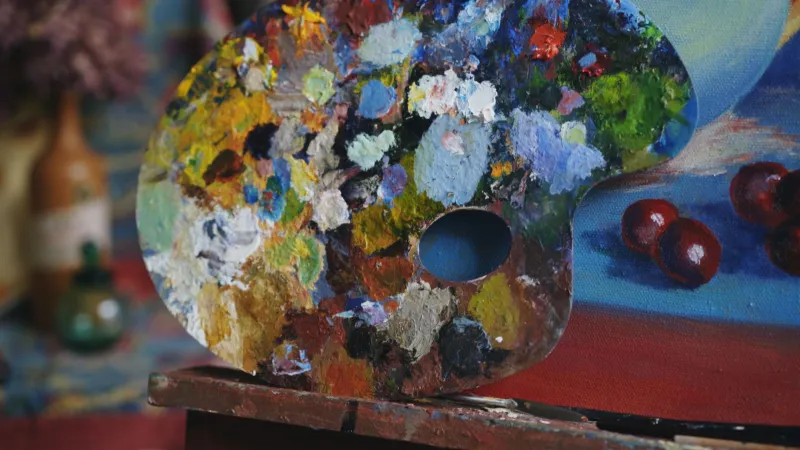
When Scales Became Swatches: How Music Theory Is Quietly Changing the Way American Visual Artists Use Color

Somewhere between learning what a diminished seventh chord actually does and staring at a half-finished canvas at two in the morning, Brooklyn-based painter Renata Voss had a moment she still struggles to explain cleanly. She'd been working through a beginner music theory course online — something she picked up mostly out of boredom during a slow stretch of commissions — when a concept about tension and resolution in chord progressions stopped her cold.
"I kept thinking about a painting I'd been stuck on for three weeks," she said. "The colors weren't wrong exactly. They just weren't going anywhere. And I realized I'd been treating them like a list instead of a conversation."
She went back to the canvas and pulled a warm ochre that had been sitting in the background forward, flanking it with a cooler blue-green she'd been avoiding. The tension was immediate. So was the release when she let the composition breathe.
She finished the piece in two days.
The Grammar Nobody Told You About
What Voss stumbled into isn't a new idea in the academic sense — color theory and music theory have been compared by philosophers and artists going back centuries, with figures like Kandinsky and Scriabin obsessing over the overlap. But what's happening now among working American creatives feels different, less theoretical and more practical. It's less "color is music" as a romantic metaphor and more "the structural logic of music gave me an actual tool I can use."
Music theory, at its core, is a system for understanding relationships — how notes create tension against each other, how scales set expectations, how rhythm controls where attention goes. Color theory does similar work, but the way it's typically taught to visual artists often emphasizes categories over dynamics. You learn complementary colors, warm and cool, value contrast. What you don't always get is a deep framework for understanding movement — how a viewer's eye and emotional state travel through a composition over time.
That's where musicians think differently, almost by default.
"In music you're always thinking about where something is going," said Chicago-based illustrator Marcus Dell, who started studying jazz theory in his mid-thirties after a friend dragged him to a workshop. "Every note implies a direction. I started asking that question about every color I put down. Where does this want to go? What does it make the viewer expect next? That changed everything."
Intervals and the Space Between Colors
One of the specific concepts working artists keep coming back to is the idea of intervals — the distance between two notes and the emotional character that distance carries. A minor second feels tense and close. A perfect fifth feels open and stable. A tritone feels genuinely unresolved, almost uncomfortable.
Several artists described mapping that logic onto color relationships in ways that went beyond standard complementary or analogous palette thinking. Instead of asking whether two colors "go together," they started asking what kind of interval they were creating — and whether that interval served the emotional intent of the piece.
San Francisco photographer and digital artist Yolanda Pryce, who started taking piano lessons at 38 after her kids did, put it this way: "I used to pick colors that were pleasing. Now I pick colors that are doing something. Sometimes that means deliberately uncomfortable pairings — things that sit next to each other like a dissonant chord. But you need that dissonance or the resolution doesn't mean anything."
Her recent series of urban landscape photographs — shot on film, then hand-colored in post — uses exactly that logic. Deep, slightly sour magentas sit next to near-neutral grays, creating a low-grade visual friction that makes the eventual warmth of a highlight feel almost like exhaling.
Rhythm and the Eye
It's not just harmony. Rhythm, it turns out, translates too.
Visual artists who've absorbed music theory often start talking about their compositions in terms of pacing — the speed at which the eye is meant to move across a surface. Strong rhythmic repetition in music creates momentum; visual artists are finding that repeating color weights or tonal values at deliberate intervals does the same thing on a canvas or a page.
"I started thinking about my illustrations in terms of measures," said Dell. "Like, every four inches or so there should be a beat — a moment of visual emphasis. And the stuff between those beats needs to be quieter, or the rhythm falls apart. I literally drew bar lines on my sketches for a while just to see if I was keeping time."
It sounds almost absurdly literal. But he swears it worked, and looking at his recent editorial work — tight, kinetic compositions that manage to feel both dense and easy to read — it's hard to argue with the results.
Not Synesthesia, Just Structure
It's worth being clear about what this isn't. Synesthesia — the neurological condition where one sense involuntarily triggers another, like hearing colors or seeing sounds — is a real thing, and it's genuinely fascinating. But the artists in this conversation aren't describing involuntary cross-sensory experience. They're describing something more deliberate: the conscious borrowing of a structural framework from one discipline and applying it to another.
That distinction matters because it means this is learnable. You don't have to be wired a particular way to do it. You just have to be willing to sit with music theory long enough that its logic starts to feel intuitive — and then stay curious about where that logic shows up in your own work.
"It's not mystical," Voss said, almost defensively, as if she'd been asked that question before. "It's just a different way of thinking about relationships. Music gave me a vocabulary for something I was already doing instinctively but couldn't articulate. Once you can articulate it, you can control it."
The Takeaway, If There Is One
None of these artists are suggesting that visual creatives need to become musicians. Nobody's saying you have to learn to read sheet music before you can pick up a brush. But there's something worth sitting with in the idea that the structural logic of one art form can genuinely unlock new fluency in another — not by blurring them together, but by letting the precision of one illuminate the blind spots of the other.
Music theory, it turns out, is less about music than it is about how tension and release, expectation and surprise, rhythm and rest work on a human nervous system. That's not a musical problem. That's everyone's problem.
And some of the most interesting visual work coming out of American studios right now is being made by people who figured that out somewhere between the circle of fifths and a canvas they couldn't crack.