Fight Club for Creatives: Why the Best American Collaborations Run on Friction, Not Friendship
Everybody loves a good origin story about two artists finishing each other's sentences. The handshake, the shared vision, the seamless creative marriage. It makes for great press. It makes for terrible art.
Or at least — it often does.
Here's the thing nobody really wants to say out loud: a lot of the most vital, weird, era-defining American creative work happened because two people in the same room could not stop arguing. Not arguing about lunch orders. Arguing about everything that mattered — direction, sound, color, structure, meaning. The kind of arguments where someone goes home furious and comes back the next morning with something nobody expected.
That's the collaboration paradox. And once you see it, you can't unsee it.
The Myth of Perfect Chemistry
We're culturally obsessed with the idea of creative harmony. Maybe it's because the messier truth is harder to romanticize. When a partnership looks frictionless from the outside, we assume it must have felt that way on the inside, too. But ask almost any working artist or musician about their most generative collaborative experience and they'll usually describe something closer to a low-grade argument that never fully resolved.
That unresolved tension? That's the engine.
Think about how many classic American records were made by people who were barely speaking by the time the album shipped. Or how many gallery shows came out of two artists who shared a studio and a mutual frustration with each other's instincts. The friction doesn't ruin the work. In the right conditions, it is the work.
Psychologists call it "creative abrasion" — the productive discomfort that happens when two people with genuinely different aesthetic philosophies are forced to negotiate a shared outcome. The keyword there is forced. When collaboration is optional and comfortable, both parties tend to default to agreement. Agreement is the enemy of surprise.
When Two Visions Collide
Look at the American indie rock scene in the late nineties and early aughts. Some of the most formally adventurous records of that era came from bands where the internal dynamics were, generously speaking, complicated. Producers who hated what the band was doing. Bandmates who pulled in opposite directions on every track. Engineers who went rogue on the mix. The records that came out of those sessions sound like arguments that somehow found a form.
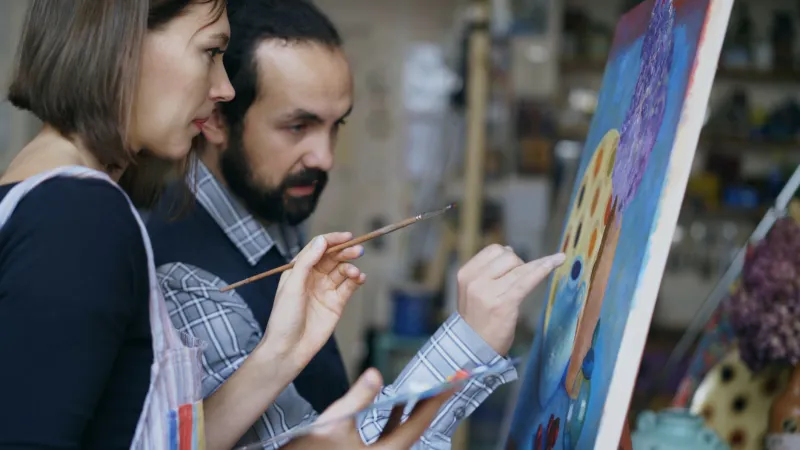
Or consider the visual art world. Collaborative painting and installation work in the US has a long history of partnerships that read, from the outside, like they should have collapsed. Two artists with incompatible color theories. Two sculptors who disagreed about whether a piece should invite touch or refuse it. What happens when neither person wins? You get something neither of them would have made alone — and usually something stranger and more interesting than either of their solo practices.
That's not a coincidence. That's the mechanism.
The Productive Argument Has Rules
Not all creative conflict is useful, obviously. There's a difference between friction that generates heat and friction that just burns everything down. The collaborations that thrive on disagreement tend to share a few things in common.
First, both people actually respect each other's instincts, even when — especially when — they disagree with them. The argument works because both parties know the other one isn't wrong, exactly. Just differently right.
Second, there's a shared commitment to the work itself that overrides ego. When the project is the priority, disagreement becomes a tool rather than a threat. You fight for something, not against each other.
Third — and this is the one people underestimate — there's a willingness to let the conflict stay unresolved. Not every creative argument needs a winner. Sometimes the best outcome is a piece of work that holds both perspectives in tension, that lets the viewer or listener feel the pull between two different ideas without forcing a resolution. That ambiguity is often where the most interesting art lives.
American Creative Culture and the Discomfort Problem
There's something specifically American about how we approach collaboration that makes this worth examining. We're a culture that loves the team-player narrative. The smooth partnership. The co-founders who complete each other's sentences on a podcast tour. We're not great at sitting with productive discomfort, either in our personal lives or in our creative ones.
But the artists who are doing the most interesting work right now — across music, visual art, performance, interdisciplinary practice — tend to be the ones who've figured out how to use disagreement as a resource. They're not avoiding the tension. They're farming it.
There's also something worth saying about how American creative institutions often try to smooth this out. Residencies designed for frictionless collaboration. Grant applications that ask for evidence of shared vision. The whole apparatus rewards harmony, which means the productive friction often has to happen in spite of the structure, not because of it.
What This Means for How You Work
If you're a creative person — musician, visual artist, filmmaker, whatever — and you've been choosing collaborators based on how well you get along with them, it might be worth asking whether you're optimizing for comfort over output.
The collaborator who challenges your instincts, who doesn't let your first idea slide through unchallenged, who makes you defend every choice — that person is harder to work with. They might also be the reason your next project is the best thing you've made.
The myth of perfect creative chemistry is appealing because it suggests that great work comes easy when conditions are right. But most of the evidence points the other way. Great work tends to come hard, from people who cared enough to fight about it.
So maybe stop looking for the collaborator who gets you. Find the one who gets under your skin a little. See what you make when neither of you can fully win.
That's usually when things get interesting.